


Welcome to Shruthi Rajasekar, our newest voice in the Graphite kaleidoscope!

“I write to create transcultural experiences that bring people together in the pursuit of representation, advocacy, and radical joy.”
New pieces:
“Palm to Palm” – accessible and tender;
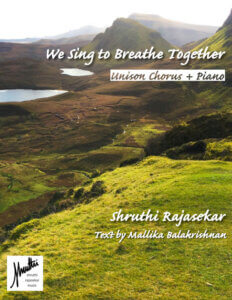
“We Sing to Breathe Together” – lively, earnest, and uplifting;
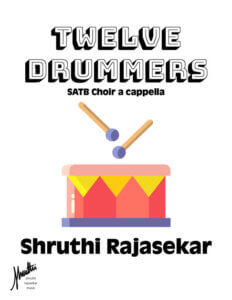
“Twelve Drummers” – short, bright, and humorous;
“Who Has Seen the Wind?” – a whirlwind of colors;
“Do Not Stand at My Grave and Weep” – loss and remembrance;
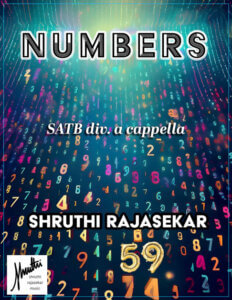
“Numbers” – synapse-busting glorification of counting;
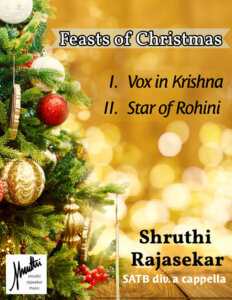
“Feasts of Christmas” – spiritual awe;
“I Am My Own” – passionate text from the Brontë sisters;
“Da Pacem Domine” – from bereft to peace;
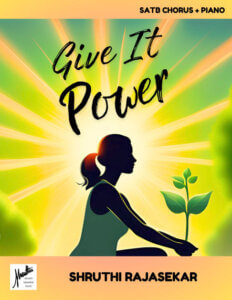
“Give It Power” – the importance of uplifting others;
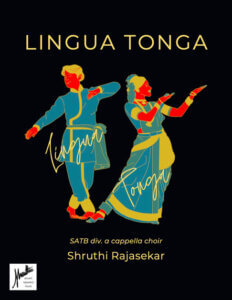
“Lingua Tonga” – an exciting, fast-paced tribute to Hindi film.
Composer and performer Shruthi Rajasekar is a McKnight Composer Fellow with the American Composers Forum, Jerome Hill Artist Fellow, Associate of the Royal Northern College of Music (ARNCM), winner of the Global Women in Music Award from the United Nations, and recipient of the Marshall Scholarship from the Government of the United Kingdom. Shruthi’s music draws from her deep roots in the Carnatic (South Indian classical) and Western classical traditions. Her work highlights identity, community, and joy.
“My mother, musician Nirmala Rajasekar, has modeled for me the integration of the traditional and the experimental,” reflects Shruthi. “She asks and wonders. She doesn’t ever close the door to possibility. She is the reason I became a multi-genre musician, when I could have stayed in Carnatic music alone (my first language of music). When most people learn of my training and background, they assume that her primary gift to me has been Indian classical music. She did that, in her formal role as my guru. But throughout my childhood, she gave me exposure to so many genres of art, including my first choral concert.”
 “I Am My Own” (SATB Choir + single handbell, Difficulty:4, 5-10 min.)
This piece weaves together Victorian-era text from the novels of all three Brontë sisters. The title comes from Jane Eyre’s declaration that she is “her own mistress.” Amidst passionate and yearning music lies the heart of the piece: a wildly experimental page that will reshape the way your choir sings and and the way your choir listens.
“I remember creating almost immediately as soon as I started learning to play and sing music,” says Shruthi. “We bought a keyboard the week before my first piano lesson, and I made up several pieces on it before I learned where middle C was. The two have always been intertwined for me but in the early years, composing was my private joy while performing was the way I would share myself to others. Once composing became more ‘public’ for me, I started to cherish my time experimenting with my voice at home, on my own.”
 “Who Has Seen the Wind?” (SATB div. a cappella, Difficulty: 3, 3-5 min.)
“I wrote ‘Wind’ almost immediately after finishing a large project that required a lot from me. I thought I would be utterly spent after writing that piece… And yet, I felt like a totally different person as I tumbled with delight into the new musical world of ‘Wind.’ Through that experience, I learned how restorative our work is – how much making the thing also makes us new. It’s like driving a car with regenerative braking; we charge ourselves through our music-making.”
Two truths, one lie:
1. Shruthi played table tennis competitively in high school;
2. She has donated her hair ten times;
3. She has hung out with a prince in his palace.
Scroll down to find the answer!
 “Do Not Stand at My Grave and Weep” (SATB div. a cappella, Difficulty 4, 3-5 min.) was Shruthi’s first complete choral composition! “I wrote it at age 18 and tweaked it a bit at age 19,” she shares. “It makes me uniquely happy when I hear from people about this work. I wrote it for an audience of one (me!), and I look back, with awe and gratitude, to where this piece has led.”
Other songs of reverence:
“Palm to Palm” (SSAA a cappella, Difficulty: 3, 3-5 min.)
Accessible and tender, this song imagines the chain of womxnhood across generations who share wisdom, experience, and love through their hands.
“Da Pacem Domine” (ATB div. a cappella, Difficulty: 5, 3-5 min.)
An imaginative setting of the Latin version of “Give Peace, O Lord” that utilizes the full expressive range of modern harmonic languages.
Globally, Shruthi’s compositions have been featured at the Royal Albert Hall (London, UK), the Cannes Film Festival (France), the National Centre for Performing Arts (Mumbai, India), Victoria Hall (Singapore), and the United Nations’ COP 26 (Glasgow, UK). She has been a performing artist and artist-in-residence at Britten Pears Arts, Tusen Takk Foundation, and Norway’s Kampenjazz. Shruthi lives in Minnesota and serves on the Board of Directors of the Anderson Center and of chamber ensemble Zeitgeist.
| Lingua Tonga | Give It Power | We Sing to Breathe Together | Numbers |
 |
 |
 |
 |
| SATB div. a cappella Difficulty: 4 3-5 min. |
SATB choir & piano Difficulty: 2 3-5 min. |
Unison chorus & piano Difficulty: 1 3-5 min. |
SATB div. a cappella Difficulty: 5 3-5 min. |
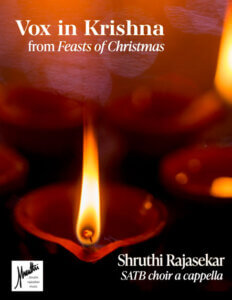
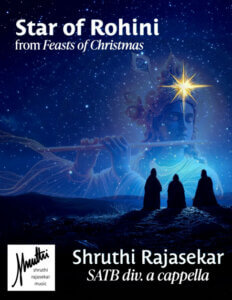
| Feasts of Christmas | Vox in Krishna (from Feasts of Christmas) | Star of Rohini (from Feasts of Christmas) | Twelve Drummers |
 |
 |
 |
 |
| SATB div. a cappella Difficulty: 3 5-10 min. |
SATB a cappella Difficulty: 3 3-5 min. |
SATB div. a cappella Difficulty: 1 3-5 min. |
SATB a cappella Difficulty: 3 less than 3 min. |
Two truths, one lie REVEAL: #1 is the lie. From Shruthi: “The only high school sport I competed in was choir, obviously.”
Leave a Reply
You must be logged in to post a comment.