

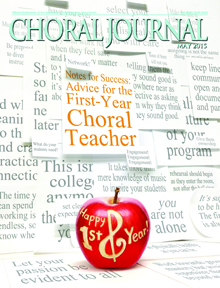
In May, August, and September 2015, the Choral Journal featured a three-part article series titled “Notes for Success: Advice for the First-Year Choral Teacher.” As part of the series, 11 choral conductors with teaching experience ranging from 4 to 34 years answered 10 questions related to setting expectations for your first year, classroom management, balancing a successful work and home life, finding repertoire, and more.
In this column, I would like to address question #1 from the May 2015 issue: How do I set realistic expectations for my first year of teaching?
A portion of the suggestions listed regarding this question follow. Please leave a comment below with a strategy that has worked for you (or perhaps one that hasn’t!) so that we can continue to learn from one another.
“Becoming a master at classroom management is vital. It does not matter what music you have selected, how extensive your musical knowledge is, or how well planned your rehearsals are. If you do not know how to get students focused and engaged on task, you will not be able to do anything.” – David Burton
“Care, communication, and conscientious repertoire selection are essential for addressing immediately in any new teaching position. First on my list of realistic expectations would be to better understand the truth found in Theodore Roosevelt’s statement, “Students don’t care what you know until they know that you care. … My students did not care to focus on what I knew from being a music major or performer; their level of trust and engaged interaction was always more directly correlated with how much they felt I cared about them.” – Darla Eshelman
“One first-year task often pushed to the back burner is potentially one of the most productive. Take time to set big goals by answering some very important questions: 1) Why do I teach music? 2) What is special/important about choral music? 3) What do I want my students to remember upon leaving the classroom? 4) What do my students need from me? From choir? From the world? Once you have answered these questions, think about how you will convey that purpose every day in your classroom.” – Elizabeth McFarland
See also:
-Question #3: How do I best balance my personal life and the stress of my job? Read it here.
-Question #6: How do I best establish a grading strategy? Read it here.
Click here to read the full article that contains the rest of these answers in Part 1 of this series. Click here to read Part 2. Click for Part 3. Note: you must be an ACDA member to read the Choral Journal. If you are not already a member of ACDA, join today! Associate members can join for only $45 a year.
Leave a Reply
You must be logged in to post a comment.