

• Sign In
  • ACDA.org
  • Skip to primary navigation
  • Skip to main content
  • Skip to primary sidebar
  • Skip to footer
ChoralNet

ChoralNet

The professional networking site for the global online choral community.

  • Home
  • Blog
  • ACDA News
  • Events
  • Community
    • Announcements
    • Classifieds

You are here: Home / Others / Real boys don’t sing soprano

Real boys don’t sing soprano

September 26, 2011 by Allen H Simon Leave a Comment


A ChoralNet user forwarded me this article:
14 year-old Garrett Adam is good at many things. Music is one of them. 

“I play the flute and piccolo in the band,” Garrett said. “And I've been interested in singing a long time now, really interested in singing.” 

He's been in junior honor choir, band, marching band and more. And as a freshman this year at Yankton High School Garret had his sights set on an even bigger challenge: all-state chorus. He signed up under the part he sings every day in choir: Soprano. 

But he got rejected from All-State choir because boys aren't allowed to sing soprano.
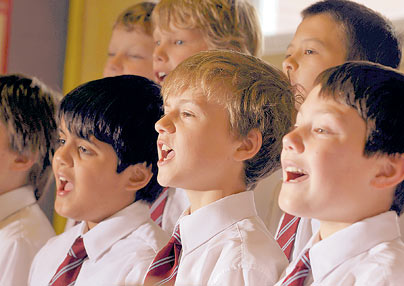
 
Now this was at the high school level, where at least there's some semblance of sense to the assumption that all boys' voices have changed, but my own son wasn't able to apply for junior high all-state choir this year because it's a mixed boys choir and all the boys have to sing tenor or bass. He's in 7th grade. 
 
We contacted the director, and he basically said "we'll just have him sing tenor 1". That's just stupid. He's not a changing voice, even; he's a high soprano. High C's are effortless for him. Gravelling out a tenor 1 part would be worthless. He's years away from his voice change. So he's not applying.
 
This can't be an unusual situation: lots of middle school boys haven't started their voice change. How does keeping them out of honor choirs help us develop the tenors and basses of the future? Aren't we just making it more likely that they'll drop out of choir and go into soccer or wrestling or something? Aren't we reinforcing the stereotype that singing high is "girly"?
 
This seems like bad policy. I poked around on the various ACDA division websites and found that middle-school honor choirs vary quite a bit; some are SATB, some SAB and some have separate boys' and girls' choirs. I couldn't tell whether the latter groups would be TTBB only. 
 
I realize that kids have to audition for honor choir in September but the conventions aren't until February/March, and sometimes voices change during that time. But it seems unnecessary to welcome only changed boys' voices. What would be the harm in mixing the genders together in the soprano and alto sections?

Filed Under: Others

Reader Interactions

Comments

  1. David Monks says

    October 6, 2011 at 4:05 am

    The mere use of the word ‘girly’ in this discussion highlights two things
     
    1. it seems to be an American thing.  ‘Girly’ is rarely used in Enlish as spoken in Europe, except in matters pertaining to girls/femininity.  Nor here in France is it a problem to have male sopranos or altos; or female basses in choirs
    2. Americans seem uncomfortable with anything that does not conform with perceived male/female roles.  In a word, what is under discussion includes sexism, and could there possibly be an underlying suspicion and /or fear of homosexuality?  Surely none of this has any part in musicmaking!
    Forcing a natural soprano voice to sing tenor could cause vocal damage.  Anyone  who insists on pursuing such a course should have nothing to do with developing voices – or any voice, for that matter. 
     
    It is difficult enough to get boys and young men to sing without adding this idiotic layer.
    Log in to Reply
  2. Carl J Ferrara says

    October 3, 2011 at 11:19 am

    This is a cultural issue as well. American culture does not embrace the high male voice as they do in Europe. Justin Bieber had a high voice, because it was unchanged, and the cultural backlash has been comedy made at his expence considering him “girly.”
     
    I often have high male altos at the middle school level, and they brave the low range simply because they don’t want to be the only boy in the Alto section.
     
    I leave it up to the comfort level of the singer. But this applies to both the comfort in singing in the range to which he is assigned, and his personal comfort in singing in that environment. I do what I can to dispell the myth of masculinity and femininity being defined by a person’s vocal range.
     
    If your son was comfortable as a high school student singing soprano, and he qualified for All-State as a Soprano, he should sing Soprano. Frankly, the All-State Music organization should know better.
    Log in to Reply
  3. John Howell says

    September 30, 2011 at 9:40 pm

    I have to agree with Eloise that this behavior on the part of supposedly-educated choir directors is simply stupid–or perhaps ignorant.  But it’s widespread.  None of our kids sang in choirs in middle school because the teacher was incompetent, and routinely put ALL boys on alto regardless of their individual voices.
     
    But I have to echo Eloise also in emphasizing that this is not necessarily always a matter of voice change.  There are indeed a good many countertenors (for want of a better term), some of whom sing soprano comfortably but most of whom sing mezzo or alto.  My son is one of them (and it is NOT “falsetto,” an outdated concept; see my son’s article about this on his website, IanHowellCountertenor).  Chanticleer is half countertenors, singing both soprano and alto and doing so quite well!  And more than a few countertenors have made a name for themselves in pop music as well, including Wayne Newton and Smokey Robinson.  (About Tiny Tim I have no opinion, except that that IS falsetto action, and nobody really knows what Michael Jackson’s voice was.)
     
    Yes, blind auditions are the way to combat this, and we in the profession should be on the cutting edge in doing away with these dumb decisions at least on the state level.  Has NO ONE taken a statistics for teachers course and learned the meaning of the normal bell curve?
     
    All the best,
    John
    Log in to Reply
  4. Gerald Gurss says

    September 30, 2011 at 8:49 am

    there should be no harm in allowing the singers to sing the part suits their voice. in my adult chorus, for example, i have 3 female tenors (most of whom can sing as low as the the tenors).
     
    the only real problems i see are:
     
    1. the students’ comfort level being around peers who may not be as tolerant or understanding and therefore suppress their expression and cause more psychological drama for the singer than a positive experience.
     
    2. one never knows when the “change” will happen. right?! i mean, you spend all that time coaching a student on whatever part, and they get in. YAY! then, by the time all-state comes around, the auditioned part may not be feasible at all. boo.
    Log in to Reply
  5. Eloise Porter says

    September 30, 2011 at 8:19 am

    I agree–this is totally stupid.  The SATB Boys Choir is a solution, but there are too few of these around. Honor Choirs should include both changed, changing and unchanged boys voices in Middle School grades.  It might seem strange to do so at the HS level, although there might be a few boys unchanged at that time.  However, these days, we do have men that prefer to sing with and develop their falsetto–counter tenors, male altos, etc.  So what’s the thinking in keeping the traditional male/female part structure?  Perhaps ‘blind’ auditions would be interesting–send in your tape with first initital and last name, and the application the same way, without gender reference.
     
    Eloise Porter
    Log in to Reply
  6. Ronald Richard Duquette says

    September 30, 2011 at 7:22 am

    Ah, and then there’s the opposite problem.  My son, now working on a voice major as a lyric baritone, was in his fifth-grade choir when the teacher wanted him to sing “high” – because that’s what she expected out of a boy’s voice.  Well, at the time, he sang “low” – comfortably, well within his range – accurately, and she didn’t even need to teach him the notes because by then he was in his fourth year of piano.  BUT, because of an “expectation” that it was only appropriate for a boy with an unchanged voice to sing “high” (ever heard of boy altos?) this turned him off for quite a while – so long, in fact, that the next time he sang publicly was for a play in his junior year in high school – and then he hit the high line in “You’ve Gotta Have Heart” from Damn Yankees.  Mind you, as he was going through this, I encouraged him to keep singing comfortably, irrespective of the teacher – and had it come to it, I would have spoken with her sharply about it – the idea is NOT necessarily to meet everyone else’s expectations, but to find a way to match both sets – or find an alternative.  But of course, schools and state choral associations are made for the mass, and not the particular, and it requires a sensitive individual to realize that individuation is not a dirty word.
     
    Ron
    Log in to Reply

Leave a Reply Cancel reply

You must be logged in to post a comment.

  • ACDA.org
  • The ChoralNet Daily Newsletter

Advertise on ChoralNet

Footer

Connect with us!

  • Home
  • About
  • Help
  • Contact Us
  • ACDA.org

Recent Blogs

  • Choral Ethics: Busy Times
  • ChoralEd, Basic Audio Setup
  • Between the Staves: Choral Questions, Candid Answers
  • Choral Ethics Guest Blog: Regarding Women in Classical Music History
  • Choral Ethics: Should We Be Responsible for Other People’s Happiness?

American Choral Directors Association

PO Box 1705
Oklahoma City, Oklahoma
73101-1705

© 2026 American Choral Directors Association. All rights reserved.
Terms of Use | Privacy Policy