

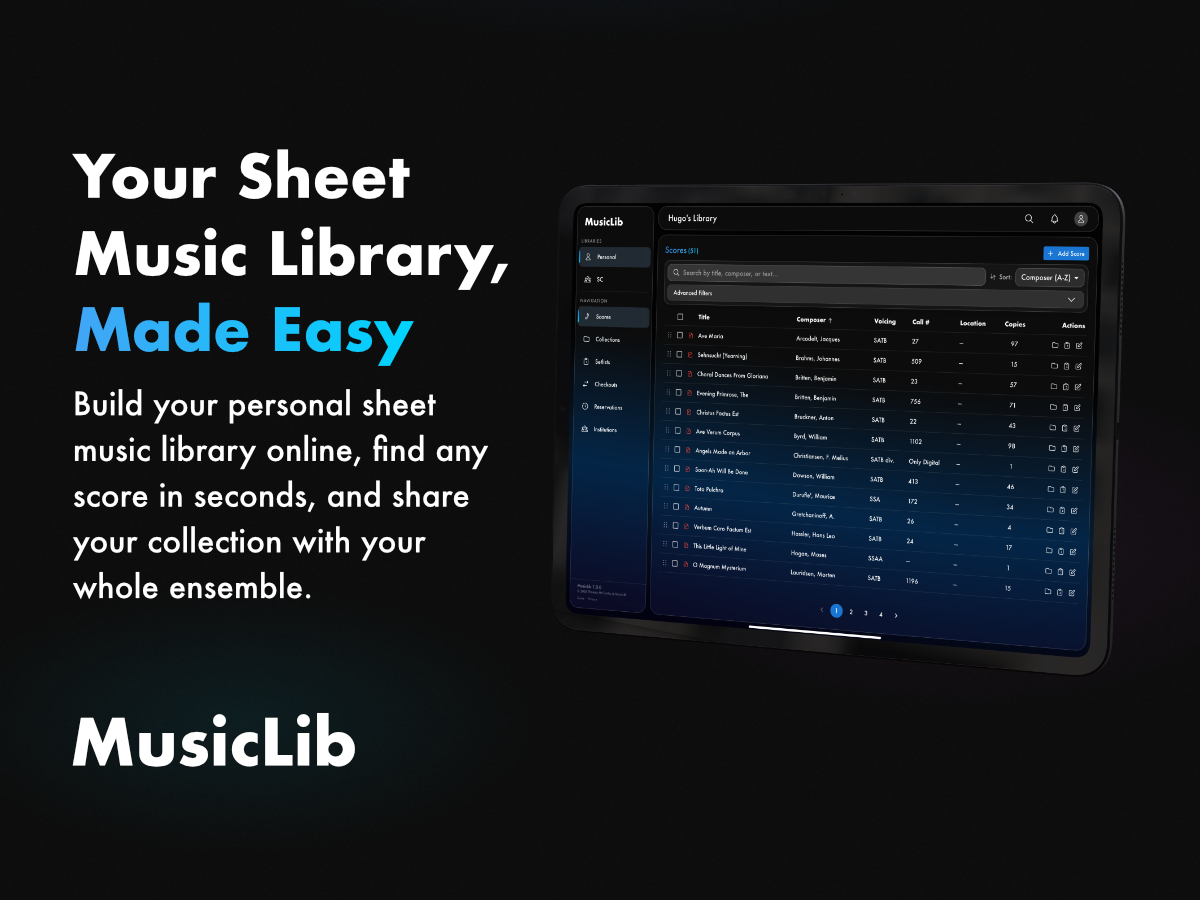
Hi everyone, my name is Thomas and I’m currently pursuing my masters in choral conducting. For the past year I’ve been working on a tool to help directors and ensemble managers organize and catalog their music libraries. It’s called MusicLib, and I’m in the early stages of opening it to the public. I’ve had a difficult time managing libraries in the past and wanted to build a comprehensive system for any kind of music library. Recently I’ve worked with a small group of professional ensembles, choirs, bands, orchestras, churches, and schools to make MusicLib into a powerhouse capable of solving many of the most common issues people face when creating (or inheriting) a music library.
MusicLib’s cataloging tools are built specifically for music, and allow you to search by music-first metadata. I’ve found when programming, it is helpful to search by instrumentation/voicing, key areas, duration, time period, copyright status, text author, and many other musical features beyond title and composer. MusicLib is equipped with powerful OCR, which will extract all the text from PDFs, allowing you to search for specific words and lyrics. I’ve found this incredibly helpful for programming thematically.
MusicLib offers a host of organizational features for tracking both physical and digital scores. MusicLib will display location, call number, and available copies for your physical scores, and will allow you to check out specific copies to individual musicians/students to help you keep track of all your scores. PDFs can be attached to every score, allowing you to review the musical content of a piece without having to pull it from the shelves. The MusicLib iPad app integrates fully with forScore, allowing you to import and export entire libraries or setlists with a single tap. If your musicians are digital-first, you can send them a .4ss file which can be opened in forScore to load all of the PDFs in concert order. The “Collections” feature works as a fully functional folder system, allowing you to create categories and subcategories to neatly organize your scores for quick access.
Possibly the biggest advantage of using MusicLib is collaboration. As a director or administrator, you can create an “Institution” and invite additional members to your shared library for free. Assign unique permissions for each member to allow your administrators full control, while allowing students or ensemble members to search the library or receive setlists without being able to modify the database or infringe on copyright. The permissions you grant to members on various tiers are fully customizable. By adding your musicians to your “Institution,” you can send scores and setlists directly to their email. Students can request to reserve a score from your library, a librarian can check out the score to the student with a due date, and students can view and manage all their checkouts from within the app.
If you or your ensembles have a library to organize over the summer, please check it out! More info can be found at www.musiclib.net. MusicLib Pro is free for 30 days then $9.99/month after that. I want to keep the platform affordable so it can be useful to as many people as possible. Similarly, any and all feedback or ideas are welcome and encouraged. Thanks for your time and feedback and I hope you have a great day!
– Thomas
Leave a Reply
You must be logged in to post a comment.